12 November, 2026
Author: Arcadie Cotruta
University deadlines abroad: Early Decision, Bocconi and IE rounds, and why applying early pays off
What Early Decision means in the US, how Bocconi's early session and IE University's rounds work, when the UCAS deadline is, and what you can still make for 2027 entry. A guide for parents.
Also available in:УкраїнськаRomână
Why the date you apply matters as much as your grades
Many parents think a deadline is simply the last day you can still send the documents. Abroad it works differently: many universities review applications in waves, and those who apply earlier compete for more places and more scholarships, and hear back months sooner.
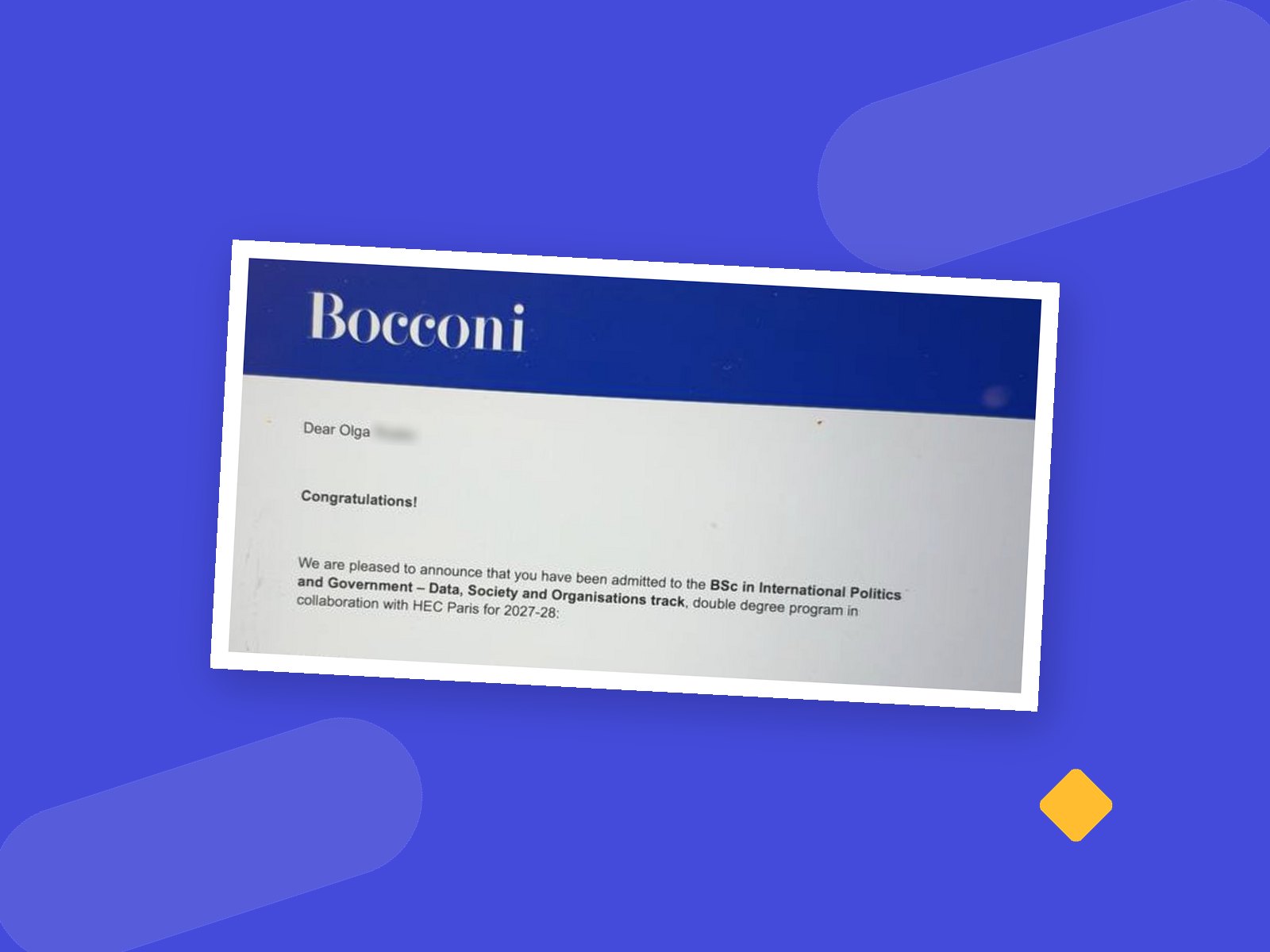
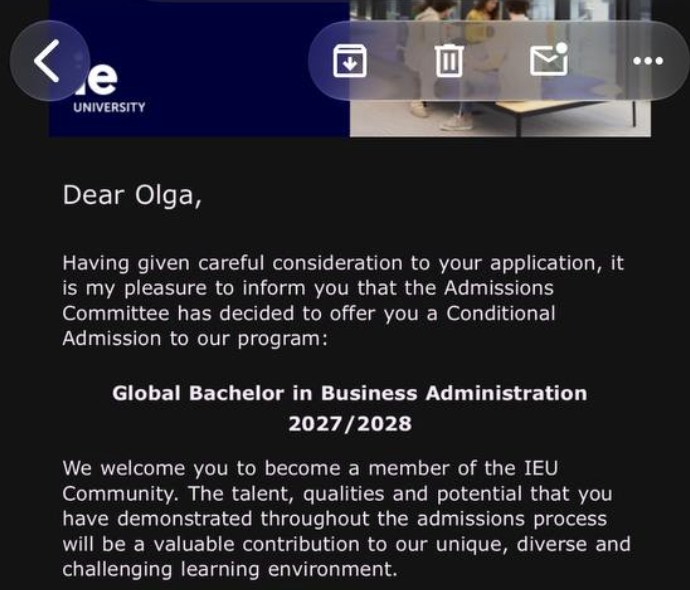
This autumn our student Olga applied in the early rounds. By early November she already had offers from Bocconi and IE University, followed by UCL, King's College London, Edinburgh, ESCP, ESADE and ESSEC. While her classmates are still writing essays, she is calmly choosing.
Below we explain the types of deadline, what Early Decision means in the US, how Bocconi's early session and IE's rounds work, and what can still be done for September 2027 entry.
Three types of deadline
- One fixed deadline. Every application sent by a set date is considered equally. This is how UCAS in the UK and Regular Decision in the US work.
- Sessions or rounds. The year is split into several application windows, each with its own results date. Bocconi and IE University work this way. Places and scholarships are handed out step by step, so fewer are left in the later rounds.
- Rolling admissions. Applications are reviewed as they arrive, for as long as there are places. There may be no formal deadline, but popular programmes fill up months before the start.
What all three have in common: applying in the last week almost never helps, and applying early often does.
The US: Early Decision, Early Action and Regular Decision
American universities offer several ways to apply. They differ in timing and in how much the decision commits you.
- Early Decision (ED): an early, binding application. If you are admitted, you agree to enrol there and withdraw all other applications. The student, a parent and the school counsellor sign the agreement. You can apply ED to one university only.
- Early Decision II: the same commitment with a later deadline, usually in early January.
- Early Action (EA): an early, non-binding application. You hear back sooner but stay free to choose until May.
- Restrictive Early Action: also non-binding, but you may not apply early to other private universities at the same time.
- Regular Decision: the standard route, usually due 1–15 January, with answers in March and April.
Early deadlines (ED and EA) usually fall on 1 or 15 November, with answers in December.
Why does ED help? The university gets a guaranteed student, so it often admits a larger share of applicants in the early round. For example, according to Common Data Set figures, the University of Pennsylvania admitted 14.7% of Early Decision applicants and only 4.4% of regular ones; Brown admitted 14.4% against 4.6%.
An important caveat: ED only makes sense if the university is a genuine first choice and the family is ready for the cost. You can usually withdraw from an ED offer only if the financial aid is genuinely not enough, and the university sets those terms. If you want to compare scholarships from several universities, Early Action is the better choice.
Bocconi: the Early and Winter sessions
International applicants to Bocconi's bachelor programmes for 2027/28 have two sessions:
- Early Session: apply from 2 to 29 September 2026, results in mid-November.
- Winter Session: apply from 25 November 2026 to 26 January 2027, results in mid-March.
Bocconi itself advises applying as early as possible: competition is intense, early applications can have better chances, and it is easier to meet the scholarship and student-visa deadlines for non-EU applicants. If the Early Session doesn't work out, you can apply again in the Winter Session.
One more date for those admitted in the early session: the Bocconi4Access financial aid application for international candidates is open from 12 to 30 November 2026.
IE University: rounds and rolling admission
IE University in Madrid and Segovia long worked on rolling admissions and now organises admission in rounds: an Early Round, Round 1, Round 2 and Round 3, after which programmes with places left keep accepting applications.
- Early Round: by 18 September 2026 (closed).
- Round 1: by 6 November 2026 (closed).
- Round 2: by 15 January 2027.
- Round 3: by 5 March 2027.
IE states plainly that earlier rounds usually have more places available and a wider range of financial aid. Our advice: if IE is on your list, aim for Round 2, not the last one.
The UK: UCAS
The UK has one shared portal, UCAS, and two main deadlines for 2027 entry:
- 15 October 2026: Oxford, Cambridge, medicine, dentistry and veterinary science (already passed).
- 13 January 2027, 18:00 UK time: the equal consideration deadline for all other courses.
Universities must consider every application received by 13 January equally. You can still apply after that date, but popular courses may already be full. Many UK universities make offers as applications arrive, so applying in November or December often means an answer before winter.
Six advantages of applying early
- More places. In rounds and rolling admission, popular programmes run out of places first.
- More scholarships. Financial aid budgets are spent from the early round to the late one.
- Time for the visa, housing and recognition of documents. Especially important for non-EU students.
- A second try. If the early round says no, many universities let you apply again later.
- Better odds in the US. Early Decision and Early Action at selective universities often admit a larger share of applicants.
- Less stress. One offer in November changes the whole final school year: your child can study calmly instead of waiting.
When shouldn't you rush? If test scores or grades will clearly improve by winter, or if the application is still unfinished. A strong application in the second round beats a weak one in the first.
What you can still make for 2027 entry
If your child is in their final school year and hasn't applied anywhere yet, there is still time, but not much:
- Bocconi Winter Session: 25 November 2026 to 26 January 2027.
- US: Early Decision II and Regular Decision, mostly 1–15 January 2027.
- UCAS (UK): by 13 January 2027.
- IE University Round 2: by 15 January 2027.
We checked these dates on the universities' and UCAS websites on 12 November 2026. Always confirm them on the official page of the specific programme before applying.
If your child starts university in 2028
For students in their second-to-last school year, the rule is simple: everything needed to apply should be ready by the end of the summer before the final year. Then the early rounds in September to November are a calm submission, not a late-night race.
- By spring: a shortlist of countries and programmes, and their requirements.
- Spring and summer: IELTS or TOEFL, the SAT or the university's own test (for example, the Bocconi test).
- Summer: personal statements, essays, recommendations, portfolio.
- September to November: apply in the early sessions and rounds.
Frequently asked questions
What is Early Decision?
An early, binding application to a US university: if you are admitted, you enrol there and withdraw your other applications. You can apply Early Decision to one university only.
How is Early Action different from Early Decision?
Early Action is also an early application, but non-binding: you hear back sooner and can choose between offers until May.
What does rolling admissions mean?
Applications are reviewed as they arrive, for as long as there are places. There may be no formal deadline, but popular programmes fill up long before the course starts.
Is November too late to apply?
No. For 2027 entry, Bocconi's Winter Session, IE University's Round 2, the main UCAS deadline and US Regular Decision are all still open. But every week means fewer places and scholarships.
Where to start
We have worked with teenagers since 2009. Our students have gone on to Cambridge, King's College London, Bocconi, Groningen, Erasmus University and NUS.
Not sure which round you can still make? Book a free 30-minute call and we'll put together a deadline calendar for your child.